Welcome to the Half
Moon Trail fishing page. It is our intent to
provide information which will create realistic
expectations about our lake. As far as Minnesota
fishing resorts go we are fortunate to be
located on Boot Lake which is a
better than average fishing lake. However,
certain times of the year are better than
others. Our earlier guests come here for the
fishing, and many of them return year after
year. We usually have some excellent June
fishing for crappies and large walleyes. There
always seem to be plenty of small northerns, a
fairly easy fish to catch. For the kids, we have
an abundance of sunfish, especially off the
docks. Out on the lake one can usually catch a
meal of sunnies, the only problem is sorting
through all the little ones to get to the bigger
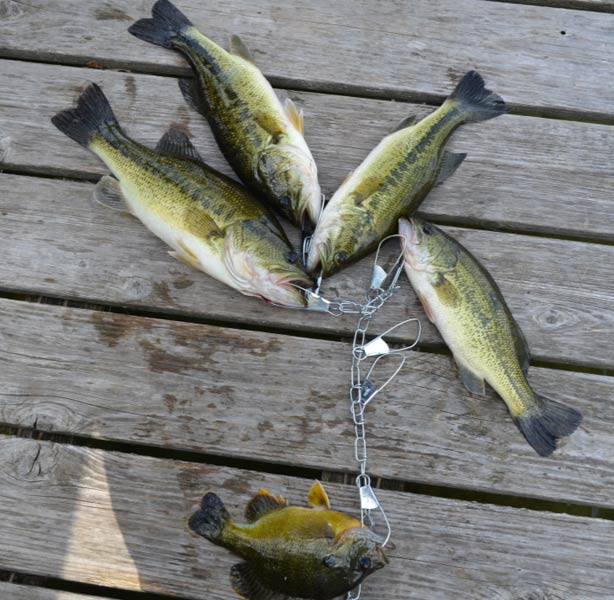
ones. The bass fishing is probably about average
most of the year. As is the case in most
Minnesota lakes, the better fishing will taper
off as you head into the warmer summer months.
If you have more questions not answered on this
page, please give us a call; Dave is always
looking for an excuse to talk about fishing.
Boot Lake
Characteristics
Our lake is very clear, with a sechi dish
reading of 16 feet. This clear water can impact
the walleyes, often delaying their peak feeding
period until the evening and into the night. The
lake is deep (109 feet at the deepest), with
some classic walleye structure, including a
sunken island and extended bars near deep water.
However most of the lake could best be described
as a bowl, with rapid drop-offs into deep water.
The main types of emergent vegetation are lily
pads and bull rushes (pencil weeds). Although we
have a sandy bottom here at the resort, much of
the lake bottom would be characterized as marl.
One significant baitfish in Boot Lake are the
ciscoes, a highly desirable, high fat food item
for the larger predators like walleyes. This is
probably one characteristic which contributes to
the lake being able to support larger
concentrations of big walleyes.
Walleye Information
For walleyes the most common method is a Lindy
rig tipped with a crawler or jumbo leech. In
this clear water, light lines are the rule,
usually 6 lb. test. Night fishing is common on
our lake. Our drop-offs zig and zag
considerably, so a depth finder (or better yet a
graph) is essential equipment if you are serious
about walleyes. There are several specific areas
which could be described as classic walleye
structure, but most of our fishermen work the
entire shoreline, varying the depth from 10 up
to 25 feet, until they start graphing fish with
consistency. Although most follow the shoreline,
trolling slowly with live bait and Lindy rigs,
some will cover more ground with crank baits.
Control of depth and lure placement are a little
more difficult with this approach, but some find
success with it. In mid-summer when the large
walleyes are suspended in the middle of the lake
feeding on suspended schools of ciscoes, a
common method of night fishing is to troll a
crankbait (ie. a # 8 shad rap) with a lot of
line at a fairly fast clip, in order to reach
these feeding fish.
General Information
We have bait available here at the resort. We
sell night crawlers, several sizes of leeches,
crappie and fathead minnows. There are several
bait and tackle stores in Park Rapids which
carry a great selection. Northern Bait (located
on the south edge of Main Street) in particular,
has all types of live bait and an excellent
selection of tackle. We carry some basic tackle,
mainly supplies to set up the basic rigs most
commonly used on our lake. The boats that are
available to rent come in two sizes(14' and
16'), with 3 motor sizes to choose from (6,10,
and 15). These are Carolina Skiffs. A broad,
flat bottomed fiberglass boat that works well on
a lake our size. These boat have plenty of room,
they are stable, and our guests love them. We
have bow and stern lights available for guests
who like to night fish. We also have a large
trolling motor and a basic depth finder
available on a rental basis.
DNR Report
Boot Lake is located in northeastern Becker
County, six miles northwest of the town of Two
Inlets. Boot Lake is a narrow, deep lake with a
surface area of 348 acres and a maximum depth of
109 feet. There is a state-owned public access
located on the north shore of the lake. Boot
Lake is best known for it's walleye population,
but also provides angling for northern pike,
largemouth bass, and panfish. The Minnesota
Department of Natural Resources (DNR) has
classified Minnesota's lakes into 43 different
types based on physical, chemical, and other
characteristics. Boot Lake is in lake class 23.
Other area lakes in this same classification
include Big Bass, Benedict, Blue, East Crooked,
Spearhead, and Tripp.
Walleye abundance (4.1 walleye/gillnet) was
within the range "typical" for this lake class
and near the current management goal of 5.0
walleye/gillnet. Walleye abundance in past
surveys has been slightly higher, fluctuating
from within to just above the "typical" range.
Sampled walleye had an average length and weight
of 17.3 inches and 2.1 pounds. A successful DNR
stocking program is maintaining the walleye
population in Boot Lake as age analysis showed
minimal contribution from natural reproduction.
Boot Lake is stocked with walleye fingerlings
during odd years. The walleye forage base is a
concern in Boot Lake as the abundance of yellow
perch (0.3 yellow perch/gillnet) was very low.
Yellow perch are an important forage species for
walleye, and there numbers in Boot Lake have
been declining since the 1991 survey. A tullibee
(cisco) population is also present in Boot Lake
and provide an important forage base for large
walleye and northern pike.
Northern pike numbers were up, with the gillnet
catch rate of 9.3 pike/gillnet above the
"typical" range for this lake class. Northern
pike abundance has been increasing in Boot Lake,
with earlier surveys at the low end of the
"typical" range and recent surveys at the upper
end of the range. The northern pike sample was
dominated by small, "hammer handle" pike with an
average length and weight of 18.6 inches and 1.4
pounds. The northern pike population in Boot
Lake is limited by high reproduction and
recruitment of young pike and very slow growth
rates. Boot Lake with it's deep water and
tullibee (cisco) forage base would seem to have
the potential of producing large northern pike,
however, past surveys have sampled very few
large pike and reports from anglers have been
limited.
Not really known as bass - panfish lake, Boot
Lake does support moderate numbers of bluegill
and largemouth bass and low numbers of black
crappie. Bluegill were small in size with an
average length of 4.7 inches and with low
numbers of fish sampled over 6.0 inches.
Bluegill growth rates are very slow in Boot
Lake. Black crappie are more of an acceptable
size for angling with fish sampled up to 10.6
inches. Moderate numbers of largemouth bass were
sampled with bass measured up to 19.4 inches.
Largemouth bass are slow growing in Boot Lake.
Other species sampled included high numbers of
yellow bullhead and moderate numbers of rock
bass and hybrid sunfish. White sucker and green
sunfish were sampled in low numbers.
Lake Map. Click here to load a DNR lake map of
Boot Lake. Lake Summary
Boot Lake has proven to be a better than average
fishing lake, especially for large walleyes.
However, due to the clear water, it is not an
easy lake to fish. The more experienced
fishermen like the challenge and potential this
lake has to offer. A novice with unrealistic
expectations can sometimes be disappointed. The
lake is managed by the DNR with a focus on large
walleyes, and they are here. However, we seldom
see limits of “eating size” walleyes. If it is
important for you to catch more smaller fish,
you would be well advised to head to a different
lake. If on the other hand, you are an
experienced walleye fisherman, or you have kids
and would just like to catch fish, like small
northerns or sunfish, then Boot Lake may be the
lake you are looking for.